
20.01 - The Choke Point – when the wind fails and the grid dies.
BEWARE OF WIND DROUGHTS, ESPECIALLY AT NIGHT
Purpose: To signal the critical situation for power security and the implication of the lowest “choke point” level of input from the sun and wind.
The Critical Issues:
(1) After the loss of several coal fired power stations we have virtually no spare baseload capacity. We are “running on the rims” with no spare tyre.
(2) Many times a year when the wind supply is critically low the system will “choke” unless conventional power sources (dominated by coal) can provide 100% of the electricity demand.
(3) Updating in 2025, the situation is becoming critical since the closure of Liddell Power Station in April 2023 took generating capacity of almost 2000MW out of the system, leaving inadequate spinning reserve in the Southeastern power grid.
(4) We are told by those in government and in government agencies that wind and solar power generation can replace coal-fired power stations as they go out of service. Due to the choke point problem that will not work because RE can displace coal but cannot replace it, as explained in note 21.07.
Key features of the situation. (Briefing Paper follows)
Recommendations.
That all politicians be advised of the critical threat posed by the choke points.
That pundits on TV, radio and print media be advised and provided with supporting information so they can pass the message to the public.
That news and weather reports include the % of demand for power being supplied by wind at the time.
Choke Point Briefing Paper
Purpose. To provide supporting information and speech dot points to explain the choke point problem.
We have an unprecedented situation in SE Australia with virtually no spare capacity to handle peak demands when they coincide with “choke points” at he minimum level of supply on nights with little or no wind.
“Choke point” conveys the urgency of the situation like the time when a person is choking or drowning and the lungs are starved of air. .
If the grid depends on sun and wind generation then parts of it will fail on nights when there is little or no wind and during daylight hours when there is heavy cloud cover and no wind.
That occurred ilast year in January (2019) when some coal-fired capacity was off line in NSW and the lights had to be turned off in parts of Melbourne. The Victorian Minister for Energy blamed the deficiencies of coal power stations, but the power station outage was the result of insufficient maintenance following a Victorian Government instruction to run at an inefficient level of output that did not generate the revenue required for additional maintenance. This demonstrated that fossil-fuelled power stations are indispensable.
Key features of the situation.
No spare capacity. With the loss of several coal fired power stations in recent years there is no spare capacity in the system. This has been signalled by the Australian Energy Market Operator (AEMO).
Liddell coal fired power station in NSW closed in April 2023 taking 1.8GW out of the system and aggravating an already marginal power supply situation.
Without additional power to replace Liddell many lights will go out at times of high demand on summer and winter evenings at peak load times.
This chart shows the situation at 6.30pm EST (5.30 Qld) on Wed 29 January, a normal weekday evening for that time of year. SOURCE https://anero.id/energy/
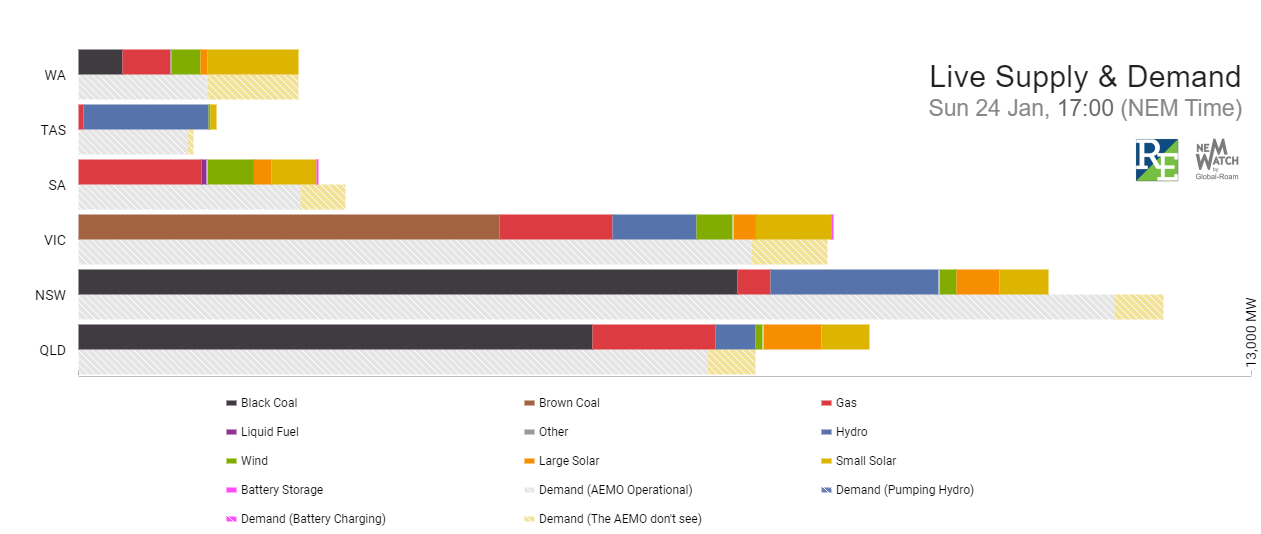
Coal (black and brown) provided 20GW to account for two-thirds of the demand.
Natural gas (purple) and Hydro (blue) each contributed about 3GW. 10% each.
The RE components are Wind (green) 1.7GW, 5.7%
Field Solar (red) 0.8, 2.7%
Rooftop solar (yellow) 1.4, 4.7%
Solar is fading rapidly at that time of day.
Conclusion. In the foreseeable future, it is abundantly clear that there is no way that wind and solar power can replace coal/gas-fired power generation. The reason is simple, lack of definable reliability due to time-of-day and meteorological phenomena which are clearly outside the control of man.
Recommendation. That the problem of the choke point in wind power be explained to politicians and the wider general public so it becomes a topic of serious discussion in political party rooms, across the media, and wherever people get together and talk about current affairs.